
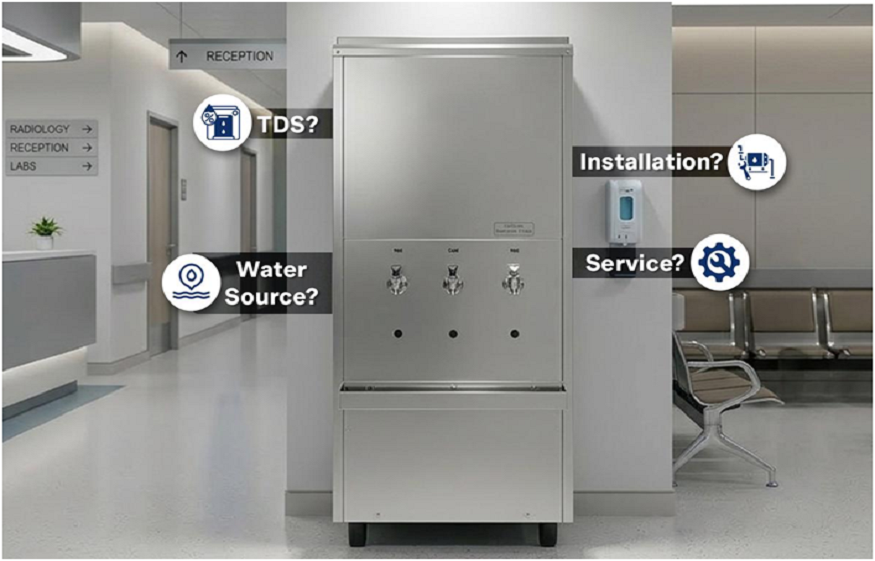
Most of the businesses do not spend much of their time thinking about how their water purification system should function until they experience problems. These problems could be anything from reduced water flow in their peak hours to unexpected maintenance expenses and inconsistent water quality. These problems often arise after the system is already in place, making it difficult to fix them later.
The installation of a commercial RO water purifier goes beyond picking which system works and installing it in the facility. It involves understanding the water quality, usage, and the availability of space. Asking the right questions beforehand can help avoid costly adjustments later and ensure the system performs reliably from day one.
Why Asking the Right Questions Before Installation Matters
Most of the problems can be solved if one asks themselves the right questions and makes the right decisions. Poor decisions often lead to buying systems that may be undersized, poorly placed, or mismatched with the water quality, leading to frequent servicing and inconsistent performance. A well-planned setup tends to run smoothly over time, with fewer disruptions and predictable maintenance.
Now, you may wonder what are these questions that businesses should ask themselves before installing a commercial RO water purifier. Not to worry, below are all the important questions along with their answers.
1. What Is the Quality of Your Source Water?
The type of water available at your workplace or any other commercial space, like malls, will dictate what type of filtration is necessary. A high TDS content will mean there are minerals in the water, and other elements could include organisms or particles.
Read More: How Freedom Forever Reviews Reflect the New Economics of Home Energy
Water obtained from borewells or tankers may have high TDS levels as compared to the water supplied by the municipality.
By analysing the water without conducting any tests, the choice of filter will be left to assumptions. Conducting a test will guide you in selecting an appropriate setup.
2. How Much Water Does Your Business Require Daily?
Start with your average daily water usage, but don’t stop there. Consider how water is used across different functions within your business, as demand is rarely uniform throughout the day. Peak hours often put the most strain on the system, and this is where capacity planning becomes critical.
For instance, if you are in the hospitality sector, like you own a hotel or a restaurant, then naturally your daily water needs will be significantly higher. In this case, RO plants are installed to ensure a seamless supply of clean and safe drinking water.
On the other hand, if you are running a small tuition centre or a coaching institute, then a single commercial RO water purifier might be sufficient.
3. Where Will the System Be Installed?
The system should be installed in a location which allows easy access for maintenance and allows proper ventilation for smooth operation.
Read More: Bathroom Water Softener Guide: Do You Need One or Not?
It is also important to keep in mind that Ro systems require a consistent electricity supply and proper inlet and outlet connections, along with a provision for reject water drainage.
4. What Are the Maintenance and Service Requirements?
Water filters need to be replaced regularly, and regular servicing is required to provide safe water to all. For this, it is necessary to ensure that quick and reliable service support is provided by the product brand. Any delay in servicing can disrupt operations and cause issues.
5. Does the System Meet Compliance and Safety Standards?
A compliance certificate from BIS and related bodies is necessary for commercial setups, as they provide drinking water to a large pool of people.
Conclusion
Installing a commercial RO water purifier is a long-term investment in your business operations. Asking the right questions before installation can help ensure that the system is aligned with the water quality, usage needs and so on.