
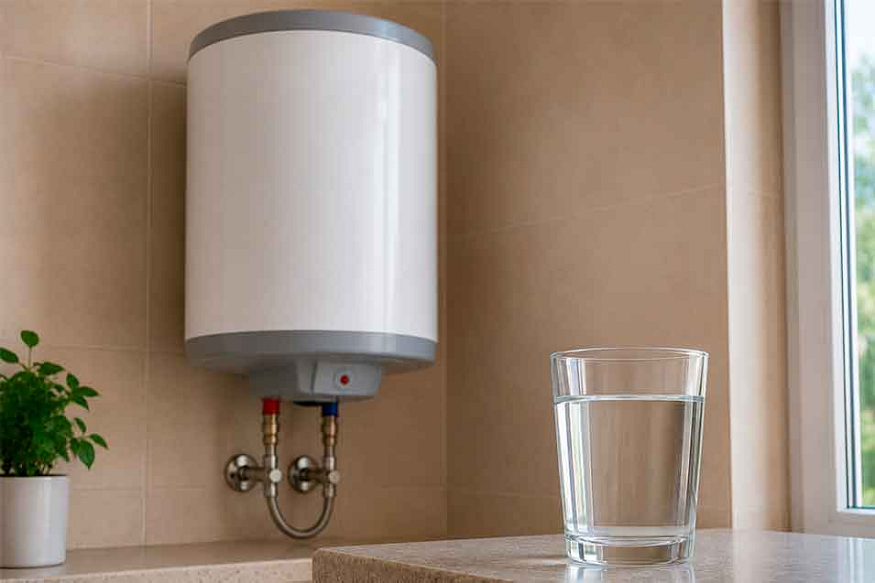
You turn on the tap, wait a few seconds, and hot water flows out. It feels almost automatic but there’s a fairly clever bit of engineering making that happen inside the unit mounted quietly on your bathroom wall. If you’ve ever wondered what’s actually going on in there, here’s a plain-English walkthrough.
The Basic Idea
At its core, a geyser (also called a water heater in many parts of the world) does one job: it takes cold water and heats it before sending it to your tap or shower. How it does that, and how quickly, depends on the type of geyser you have. Something we go into detail on in our guide to the different types of geysers, but the underlying principle is the same across most models.
Read More: Before You Install a Commercial RO Water Purifier, Ask These Questions
Step by Step: What Happens Inside
- Cold water enters the tank. Water from your main supply line enters the geyser through an inlet pipe, usually near the bottom of the unit. A dip tube guides this incoming cold water down to the bottom of the tank, keeping it separate from the hot water waiting near the top.
- The heating element does its work. Inside the tank sits a heating element, typically electric (a resistive coil) or gas-powered (a burner beneath the tank). As cold water settles near the bottom, the heating element activates and begins warming it. Because heat rises, warmed water naturally moves upward through the tank.
- The thermostat keeps things in check. A thermostat continuously monitors the water temperature. Once it hits the set point, commonly somewhere between 50°C and 65°C for household use, the thermostat cuts power to the heating element. This prevents overheating and keeps your energy bill from creeping up unnecessarily.
- Hot water waits at the top, ready to go. Since hot water is less dense than cold water, it naturally rises and collects near the top of the tank, right where the outlet pipe is positioned. The moment you open a hot tap anywhere in the house, pressure from your main supply pushes this heated water out through the outlet and into your pipes.
- The cycle repeats As hot water leaves the tank, cold water flows in to replace it, and the thermostat kicks the heating element back on when the temperature drops below the set threshold. This is why a geyser can keep supplying hot water throughout the day rather than running out after one use though how much reserve you have depends heavily on tank capacity.
Instant vs. Storage Geysers: A Quick Note
Not every geyser stores water. Instant (or tankless) geysers skip the storage step entirely water is heated on demand, as it flows through a compact heating chamber, which is why these units are smaller and heat up almost immediately. Storage geysers, on the other hand, keep a reserve of hot water ready at all times, which is better suited to households with higher or simultaneous hot water needs. We break down the pros, cons, and best-use cases for each in our detailed guide on types of geysers.
Read More: How Freedom Forever Reviews Reflect the New Economics of Home Energy
Why Understanding This Matters
Knowing the basic mechanics isn’t just trivia it actually helps with everyday decisions. If your geyser is taking longer than usual to heat water, or the water isn’t as hot as it used to be, understanding which part of this process might be failing (the thermostat, the heating element, sediment buildup at the bottom of the tank) makes it much easier to troubleshoot. We’ve put together a full walkthrough on how to fix common geyser problems if you’re currently dealing with one of these issues.
And if you’ve ever had a moment of hesitation before drinking water straight from your geyser line, that’s a fair question too. We cover exactly whether it’s safe to drink water from a geyser in a separate guide, since the answer depends on a few factors most people don’t think about.
The Takeaway
A geyser’s job looks simple from the outside: cold water in, hot water out, but it relies on a coordinated system of inlet control, heating, thermostatic regulation, and pressure-driven flow to work reliably every single day. Understanding this cycle makes it much easier to spot when something’s off, choose the right type of geyser for your home, and get more consistent performance out of the one you already have.